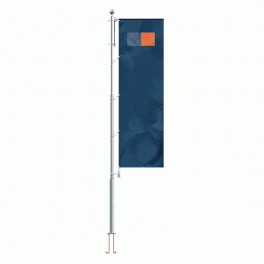
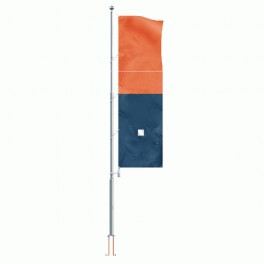
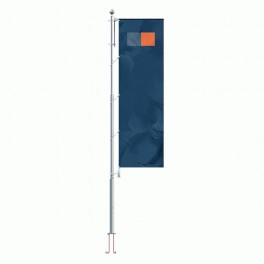
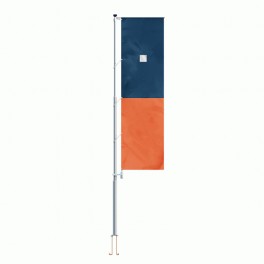
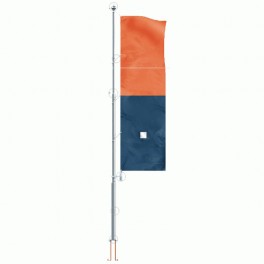
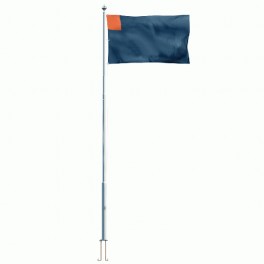
Flagpoles with a height of 7 m, ideal for displaying your flags. Quality materials and a stable construction for long-term use.
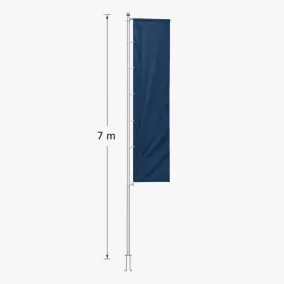
7-meter flagpole in practice: where height and stability of the structure start to matter
A 7-meter pole belongs to a category where basic visibility is no longer the only concern, and the real visual impact in space begins to be addressed. Compared to shorter solutions, it appears more dominant, the flag is readable from a greater distance, and it stands out better in environments with buildings, trees, or heavy traffic.
In practice, this dimension is used where the flag needs to represent a brand or institution at first glance, without the need to approach the object.
What changes compared to 5 and 6 meters
The difference between 6 and 7 meters is not just visual. At 7 meters, stability, wind load, and proper anchoring become significantly more important. The pole works with a larger lever of wind, meaning that the quality of the material and the foundation solution is more crucial than with shorter models.
From an operational perspective, the behavior of the flag also changes – it is more exposed to airflow and "lives" better in space, which increases its visual effectiveness.
Types of construction and their real significance
Basic pole with external cable
- simplest construction and assembly,
- lower maintenance requirements,
- visible cable control,
- suitable for less exposed locations.
This solution is used where the pole is part of a facility and there is no risk of frequent manipulation by outsiders.
Internal cable
- protection against vandalism and flag theft,
- quieter operation in the wind,
- cleaner visual impression,
- higher comfort during long-term maintenance.
At 7 meters, internal guidance is often not a "comfort accessory," but a practical standard in public or semi-public spaces.
Rotating arm
The rotating arm has a greater effect at this height than with shorter poles. The flag is more stable and less dependent on wind direction. This is especially important for corporate logos, where readability is key to visual identity.
Crank mechanism
At 7 meters, handling the flag without a mechanism starts to become impractical. The crank is not a luxury here, but a way to maintain regular flag changes without unnecessary physical strain and the risk of damaging the fabric.
Most common uses in real projects
- main entrances to corporate facilities,
- car dealerships and showrooms with higher visibility from the road,
- logistics and industrial areas,
- public buildings emphasizing representation,
- commercial zones along main thoroughfares.
In these locations, the pole is no longer just an accessory, but part of the visual navigation system of the object.
What matters in the selection more than price
At 7 meters, it becomes evident in practice that the price difference between individual versions is often less important than the method of use. The greatest influence comes from the frequency of flag changes and access to the pole.
If the flag is handled regularly, the difference between external and internal cables will manifest after a short time in terms of service speed and lower error rates during handling.
The wind in the area is also important – a 7-meter pole in an open space without obstacles behaves completely differently than the same model in an urban environment.
Why 7 meters appears more representative
A height of 7 meters creates a natural visual point in space. The flag is not just an accessory to the building, but a standalone orientation element that captures attention even before the visitor enters the object.
In practice, this means that a properly chosen pole can influence the first impression of the company even before a person reaches the entrance.